Have a question about guitar repair? E-mail me HERE

 Hand Made Repair Tools

Home

About

Here, you will find a few of the tools I have made for the shop.
Click on the photos for a larger view.

 Fret Files

                The two wooden blocks are laminated oak 1" X 2" planks (2). They have been tapered and sanded for fret file handles. The files are cut from single cut, second step mill files. The files were made in the shop at work with a die grinder and a large bench grinder. CAUTION: Cutting hardened metals such as files can be dangerous. If you decide to make these and you are not familiar with metal cutting and grinding equipment, get a friend who has done this type of work before to help you. Wear eye protection and thick work gloves.

                The end edges of the files on the single cut side are beveled so they will not catch on the frets. Using a two part epoxie, glue the files on to the bottoms of the handles with the single cut mill side out. They only file in one direction.

Photo Gallery

Reviews

Contact & Map

Links Main
Page


facebook

 Fret End Bevel Files

                The fret bevel files were a little more complex but fun to make. The files are the same single cut, second step mill files used for the fret files above. They are also beveled on the ends to avoid catching on the fret ends.

                If you look closely at the ends of the handles, you will see the cuts that run length ways down the handle (click on photo). These were cut on a table saw, one at 20 degress and one at 30 degrees so the files fit snug in the cut. This is so when the files eventually wear out, they can be replaced with new files.

Guitars4VetsLogo

                In the photo at the left (click on photo), you can see the clamps that hold the files in the slots. The aluminum clamp plates are slightly bowed length ways to put pressure on the wood when the bolts are tightened to hold the files in place. This makes the handles re-usable instead of gluing the files in and throwing them away when the files wear out.

                The file edge extending below the edge of the clamp plates is just enough to mill the ends of the frets. Always test your hand made tools out on garage sale guitars before putting them into real time use. Testing leaves room for error and corrections.

                The final photo shows the under side of the files. This is the side that goes against the fret tops while beveling the ends. This is a better view of the amount of file edge the extends below the handle. The handle ends have to be rounded to but keep the surface that contacts the fret tops flat. The wood surface has been permeated with hot wax to allow it to glide across the frets.

                These files turned out really well and prepare fret ends to general bevel for final dressing. Building tools can be a time consuming project, but crafting a tool and using it is very rewarding. For another how to on fret bevel files click here.

 The Bench Top Guitar Workstation

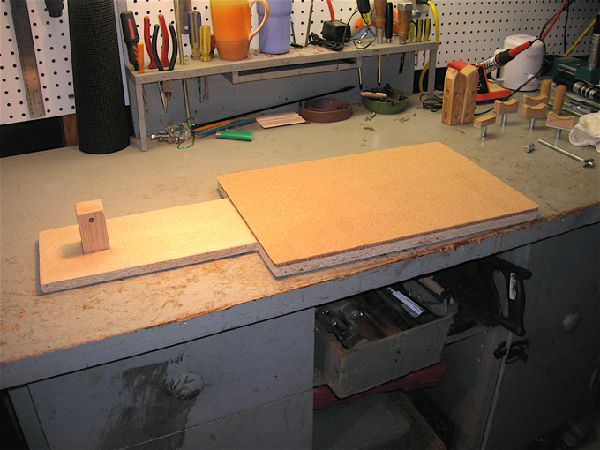
                First, I had to come up with the tasks I wanted a guitar workstation to do. Generally, for the base, it has to hold all size acoustic, electric and bass guitars as well as any other fretted instrument I may want to use it for large or small.

                The top, where guitar bodies rest, is cork covered.

                I needed to have my work held steady so I added rubber feet. The base does not teeter and sits firmly.

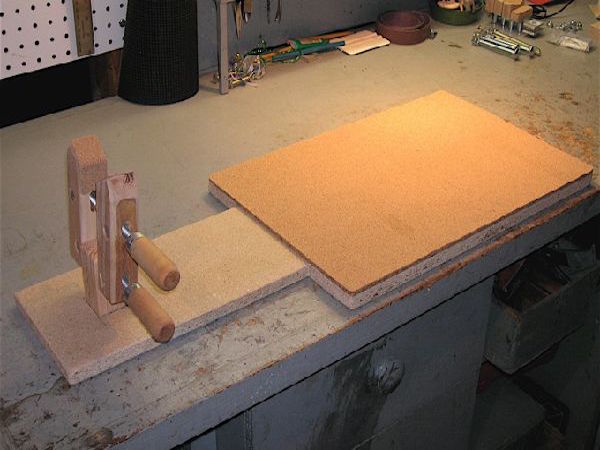
                I wanted something to hold the neck but it had to be flexible. I wanted it to pivot front to rear to hold any size instrument. It had to clamp high as well as low, closer to the base. A 6 inch wood clamp would work perfect but the handles were on opposite sides. I disassembled it, added cork to the jaws and the 'V' at the top for a neck rest when I didn't want the neck clamped.

                I made a hardwood tower to hold the clamp and a hole for the lower clamp adjusting screw to go through. The tower makes it high enough to hold deep bodied acoustics. The clamp screw running through the tower allows me to lock the clamp in place once the neck is clamped or just sitting in the 'V' at the top.

                Simple, yet funtional. Because the clamp screws pivot inside the clamp jaws, they do not have to be in perfect parallel alignment to work. The top clamp handle clamps the guitar neck while the bottom handle tightens the bottoms of the jaws against the tower. This holds the clamp and the guitar steady so there is no back and forth movement.

The Neck Jig

                The neck jig design I chose is quite different than the most popular tool sold by Stewart MacDonald. There are a lot of the Stew-Mac jigs in luthier and repair shops and a lot of folks who built their own after the same design. It is undoubtedly a beneficial tool to have as so many use them daily and swear by them. Had I chosen the Stew-Mac tool to use for my design, it too, would have seen significant changes like the one I chose did. Therefore, I will not compare the two tools, but just show you what I built. Who knows, I may decide to jump on the Stew-Mac tool sometime and build a jig from that design.

                In the above photos are the jigs guitar neck cradles. The first photo shows the oak cradles cut to form a rest for guitar necks. The "T" shaped pieces are bases that will hold the cradles on top of adjustment posts.

                The second photo shows the cradle assemblies cork lined to protect guitar necks. The flat assembly in the foreground actually rests on the heel of the guitar neck and does not require the cradle shape.

                The two photos above show the main jig body. This is where modifications to the design begin. I wanted the jig to mount in a clamping workmate table so I could get 360 degree access to the guitar while working on it. Also, it allows me to have two guitars working at the same time freeing up the bench top for a guitar in the workstation. The table is a Black & Decker Workmate and is one of the original models with spread stance legs to insure against tipping. It is very old (about 30 years), is made of steel and is very sturdy unlike newer, plastic workmate tables. If you click on the left photo, you can see the base on the jig is designed so it cannot pull up from the workmate boards once it is clamped in

                The second major modification to this jigs original design is the addition of an adjustable table to hold the guitar body. The aluminum channel was extended 5 inches and a table support added. The left photo shows the support on the left and the guitar body table on the right.

                The right photo shows most of the parts prior to assembly. All surfaces where a guitar will touch are cork lined. The hand made tools on this page have endured rigorous testing and tweeking to ensure intended results and ease of operation.

                The photo above shows the neck jig assembled except for the guitar body table and retention straps. The finished jig in use is pictured on the guitar repairs page.

The following link shows the construction of a neck jig based on another style of tool. click here.

Guitar Blankets

                This guitar blanket is one reason I like studying different guitar tech and luthier web sites for ideas. I have seen many different covers for guitars while working on them from nothing at all to cardboard, terry cloth towels and plastic cut outs taped down. When I saw this one (which is not that unusual), I knew this was a good idea. This is split suade ordered thick, but as you can see is very supple as well. I tested this on an acoustic guitar I use for experiments and found that low altitude tool drops leave no dings or marks at all. It's great for any unmentionable accidents that might happen while repairing an instrument.

                The photo on the left shows a good detail of the fret board extension cut and the under string flap cut. The cuts can be taped down if needed. The flap is cut to fit most 24 3/4" to 25 1/2" scale acoustic and electric guitars. I ordered the suade from Tandy Leather Factory and was only $35.00 for two large sheets and included shipping and tax. I use smaller cuts for spot covering where needed.

Fret Height Dial

                After fiddling around with a straight edge over two adjacent frets and feeler guages trying to figure out fret heights, two episodes was enough for me. Besides, I wanted to know the fret heights, not the space between the two frets. Stewart MacDonald has a tool similar to this but mine is cheaper and I believe works better. A dial indicator from Harbor Freight, 3/8" X 3" brass pipe and a small knob from Lowes and we're in business. A couple of notches in the bottom with a round file, drill a hole and tap for the lock knob, file the pipe threads off and flatten the bottom and I'm measuring frets with ease and accuracy : >)

                Once you have set it up by leveling it on a piece of glass, locking the base and setting the dial to zero, you can zip along measuring frets length ways and across the fret board. It will slip between the strings tuned to pitch and is a one handed operation. It doesn't measure string height because of the spring tension on the indicator shaft, it tends to deflect the string for an inaccurate reading, but for fret height, it's a dream. For string height, Stewart MacDonald has a great tool (see below).

 Return to Repair Tools main page

 Copyright©2010-2012 Accu-Tech Guitar Repair LLC. All rights reserved

Site Map

Guitars4VetsLogo HGWTLogo BEMLogo